Eve Online Astronomy Club

3I/ATLAS (or 31/Atlas) is emitting a mix of typical cometary materials like carbon dioxide (CO2) and water, but also bafflingly emits a nickel-rich alloy (like nickel tetracarbonyl) with little iron, a compound usually found in industrial manufacturing, leading some scientists like Avi Loeb to question if it’s entirely natural.

Natural Hypothesis: Some researchers postulate that a natural version of the carbonyl process occurs near the nucleus of 3I/ATLAS, where volatile nickel tetracarbonyl breaks apart under UV light to release nickel and carbon monoxide.

I used to think sending a communication signal into space would be easiest means of communicating with an alien. But what if an alien species discovered Earth using advanced planetary transiting methods that are more pinpoint and accurate than Earth’s?

The easiest method of communication would be to send a large asteroid, like 31/Atlas, that would emit non-natural toxins associated with manufacturing to determine if Earth was capable of understanding that an industrialized species also existed in space.

Or 31/Atlas could have been a warning from an alien species capable of industrialization that wanted to warn us of an impending assault on Earth. Miners taken as slaves could have found a way to use 31/Atlas, like a pigeon carrier, after overhearing discussions that a planet with life on it, Earth, had been discovered.

Fun with Math

?67 = 13(+) or 4, 42(+) or 6

?67 = 13(/) or 3, 42(*) or 8
When 6 and 8 are added the result is 14 or 1+4 = 5
?67 = 13(-) or -2, 42( - or /) or 2 and 2 = 4

4 goes in 8 twice

3 goes into 6 twice

The difference between 3 and 4 is 1 (8)

The difference between 6 and 8 is 2 (16) or 7

The difference between 5 and 8 is 3 (16) or 7

The difference between 4 and 8 is 4

8 and 7 = 15 or 6
7 and 4 = 11 or 2

AI Generated - Skin Walker Ranch and 3i/Atlas

How do the particulars of the ceramic pieces discovered match the particulars of 3i/Atlas? Both appear to come from a highly industrialized civilization and are usually not naturally occurring on Earth.

Natural semi-conductors

Natural semiconductor materials were created when the Earth was perhaps as young as 100-200 million years old.

While natural superconductors (like miassite) are rare and found in specific Russian locations, and deep mines exist globally (South Africa, USA), the specific discovery of natural semiconductors exactly at 470 feet isn’t a widely publicized, distinct event; rather, scientists study deep-earth minerals for potential semiconducting properties, with general potential areas identified in places like Western Canada, Australia, the Amazon, and Africa, suggesting such findings might occur deeper in unexplored deposits rather than a specific, shallow 470-foot marker.

Western Canada does line up with the region where the Unitah Ranch is located at.

You’re likely looking for locations where deep-earth exploration reveals materials with semiconducting properties, but 470 feet isn’t a common benchmark; expect discoveries in deep mining areas or lab-grown minerals, not necessarily a specific shallow spot.

I would have to say that the ceramic is lab-grown due to it being discovered in a relatively shallow spot.

Everything non-extra-terrestrial, aliens, must be thought about as a cause and then eliminated if the particulars don’t match up.

Could an asteroid have struck Earth somewhere in western Canada that sent ceramic debris in all directions, including Unitah?

1 Like

The elements that form semiconductors like silicon were created even longer before the moon was formed.

/ asteroid’s impact earlier than we could imagine.

Then please, explain the ceramic pieces found at SWR.

Theia was impacted with another large object (Mars-sized protoplanet) before striking our rocky planet that is now called Earth.

1 Like

Moon Phases 2026

A Parent’s Guide to Aliens in Science Fiction

For parents concerned about the alien aspect of trek and other sci-fi shows, the wearing of costumes for the Breen, Romulans, Klingon, etc. is not queer affirming nor is it aversion to how a Hoomon looks. Pressing a button on a wall, the blast doors open, slowly revealing at least 10,000 habitable worlds. What makes each species the same but physiologically different is the location of each home world’s location in the Goldilocks Zone around the star. Depending on much landmass and water is available will determine if life exists on both land and sea and in the air. Life will adapt to its surroundings and grow from there. There is nearly an infinite number of positional and orbital models of a planet within the Goldilocks zone based on gravitational influences and other factors.

If Mars had Earth-like conditions (water, atmosphere, magnetosphere) in its current orbit, humans living there for generations would likely evolve to be taller, thinner, with lighter skin/hair, weaker bones, and less muscle mass due to Mars’s lower gravity (about 38% of Earth’s) and dimmer sunlight, potentially becoming adapted to a colder, slightly dimmer world with less UV.

If Earth were twice the size in the same Goldilocks Zone, humans (or human-like beings) would likely evolve to be shorter, stockier, with denser bones and stronger muscles to cope with roughly double the gravity, resulting in robust, powerful bodies, perhaps with broader feet, to manage the intense weight and pressure, potentially looking like “superheroes” with lower centers of gravity.

If Earth spun twice as fast (12-hour days) in the same spot in the Goldilocks zone, humans would likely evolve to be shorter, stockier, with stronger bones and larger feet/hands to cope with increased centrifugal force (making us feel lighter at the equator but pulling water & atmosphere outwards) and much more intense winds/storms, while adapting to rapid day-night cycles (12-hour days), requiring different sleep patterns and potentially larger eyes for dim light, all in a world with massive coastal flooding, altered climates, and more violent weather.

If Earth remained its current size and rotation but moved just outside the Goldilocks (habitable) zone, humans would evolve into either stout, insulated “Cold-Dwellers” (outside the outer edge) or slender, heat-dissipating “Heat-Stickers” (inside the inner edge).

On a planet orbiting a smaller, cooler star (like an M-dwarf or Red Dwarf) just outside the habitable zone, humans would evolve to handle perpetual cold and dim, infrared-heavy light.

On a planet orbiting a larger, cooler star (like an Orange Dwarf or K-type star) just inside the habitable zone, with three moons, humans would evolve into lanky, heat-dissipating “Light-Seekers” with complex biological rhythms and specialized vision.

Like I said, there are nearly an infinite number of possible outcomes based on a finite number of input variables.

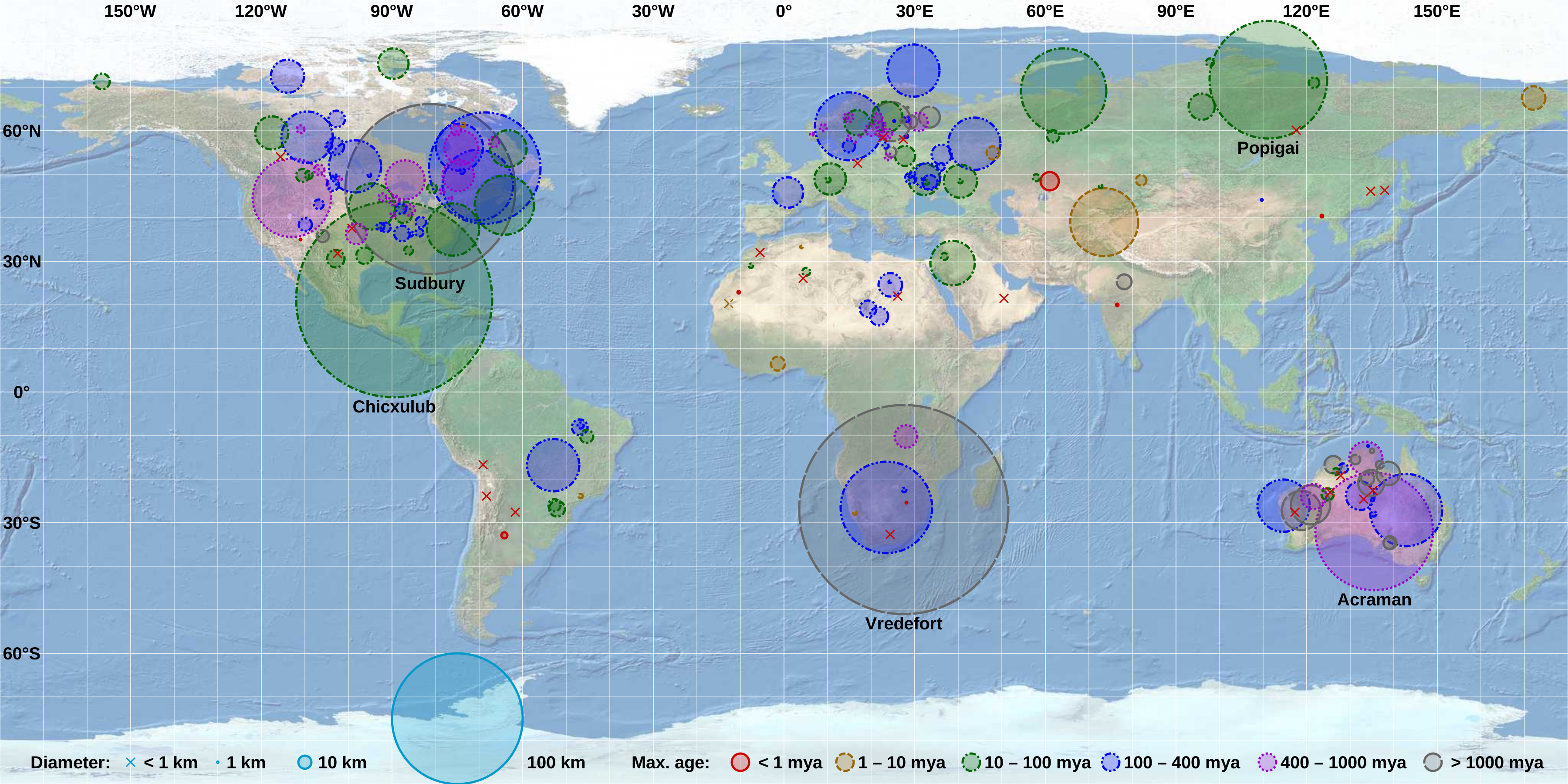
This is interesting. If you look at the Moon through a telescope, the Moon is littered w/ impact craters. But on Earth, the most notable crater impacts are on land The major areas do form a line to split Earth into sections.

Nadir Crater - Google Search

Earth Impact Database world map

When you overlay the impact locations on the map above with the era the impacts took place, it is very clear that the impacts were designed to break the mantle into sections that would help plate tectonics move the continents around.

How far from the Earth’s current orbit around the Sun could the large asteroids that struck the Earth in the past actually have moved Earth? 3i/Atlas, Oumuamua and other large asteroids that have come close to Earth could be part of the same asteroid train that collided with the Earth in the past.

What the aliens don’t want us to know. P*ss off I’m human.

Infinity is always a loop. This is proven by the rain and the snowflake. As the raindrop falls through the atmosphere and changes to a unique snowflake and then to another unique snowflake based on atmospheric conditions until the snowflake reaches the ground, there are numerous layers of infinity based on the infinite potential of each water drop to become a unique snowflake. But there is only infinite potential in the water drop as it returns to the clouds from the ground. The water drop to a snowflake is similar to the Sun as the sun is to the red blood in our veins. The water drop that is returning to the clouds is like the Moon, no life, but necessary to return life to the heart to be filled with life again.

I recently came across a video of microrobots pushing two cells together. I did some research and discovered that microrobots are just now coming into existence, via human development. An ancient civilization though, more advanced than humans, could have seeded not only Earth but other habitable planets with microrobots that could rapidly assemble cells to create the first humans and primates. Humans are a predatory species. For a species to take at least eight to ten years to grow and be able to fend for itself in a world of dinosaurs and other apex-predators, doesn’t sound much like a high chance of survival. Only an advanced species, already fully developed would have been able to survive back then.

There could be a container of sorts buried deep under SWR that is the remnants of a microrobot rapid human assembly
automated facility. Obviously, there was life on Earth before humans, and humans only came about after the dino-unliving asteroid struck Earth. The rapid human assembly facility lands on Earth and collects samples of primate DNA then adds stored DNA factors associated with advanced thinking and sentients. Once the first humans were biologically assembled, the microrobots disintegrate without a trace.

A rapid biological assembly plant could explain the reason why a female is not talked about as being necessary for God to create human life on Earth compared to creation myths before the Bible that always had a male and female needing to be necessary to create human life. Not really myths, but proven matter of fact.

Creating two sexes with inverse sexual organs would have allowed the seeding of life to proceed creating an advanced and more capable human instead of constantly needing new matter to continually create non-sexual organ-based life.

Humanoid like life, not robots, could have planted a rapid biological assembly facility on Earth, maybe as an emergency facility designed to plant the seeds of sentient life on Earth without some hostile threat force chasing the Seeder ship from discovering life had been planted here.

If the anomalies of SWR match up to frequencies needed to move microrobots around during rapid biological assembly, then we have a very serious f*cking problem to deal with.

Particles dont decay on command. Particles decay after Quantum level of interactions have transferred the energy of the particle back to a state of replenishment.

The Moon and night is like blue blood, some life but not like the day or the Sun, the red blood, full of life.

Snowflakes are the same but the opposite. Water drops, red and blue at the same time, full of infinite potential, are carried into the clouds to become infinite snowflakes.

Particles are part of the same circulatory system. The particle appears to simply end but it has merely become energy after it returns to the heart of the Quantum world.

More like the Big Bang was the exit point of our ancestors universe. A universe that was attacked by powerful and vile, Gods’ who only see their own vanity as true life…we survived.

An ancient species could have used micro robots to rapidly assemble the human body to survive on Earth. Microrobots have just recently been used to bring two cells together. Think about it, DNA is like a high-rise building that needs scaffolding around it. Micro robots would be that scaffolding. Once the first thousand humans were created, the micro robot scaffolding would have dissolved or maybe stored inside DNA itself. Once on Earth the micro robots used the available elements to construct new DNA from. This allows numerous alien species to be created based on the available elements.

Three Proofs.

  1. Particles full of energy, red blood cells, will run the course of their existence of energizing quantum layers. A particle that seemingly disappears has not. The particle disappears and becomes blue as it returns to a location of rebirth in the quantum layer.

  2. Red blood cells providing oxygen to muscles and other organs are depleted of oxygen and return to the heart to be re-oxygenated.

  3. The Moon is cold and no life, but carries life back to renewal due to gravitational forces on the Earth ensuring some aspect of working against a gravitational force is present. This is proven during the night when all types of flowers close their petals. The Sun, the red blood cells, full of light and brings more energy back to the Earth.

What is fascinating is when the Moon and Sun both occupy the daytime. Deoxygenated red blood cells (blue) occupying the same moment as the red blood cells. When the Moon and Sun occupy the day must be some point in time, in the past when depleted blood cells and oxygenated blood cells were both underdoing depletion and regeneration at the same moment in time.

  1. When there is only rain, either during the day or night, infinite potential exists.

  2. When snow and rain exist during the day, the sun melts some of the infinite potential snowflakes that then refreeze and become new, infinite snowflakes, while other rain drops continue to the ground as potential. Thus, the rain is both infinite potential and potential at the same time. When the clouds release all snow, that is infinite potential that melts into the Earth, is stored in the ground, like depleted blood is held in the heart and re-oxygenated with potential as the water evaporates back into the clouds.

The fog and mist are merely different variances of infinite potential.

There has to be a way to trigger particles with mass to allow quantum layers to use the depleted energy that would reduce mass on a ship, while at the same time providing nearly an infinite power source by harvesting the energy from the quantum layer before the depleted energy is teleported someplace else for re-energization.

Yes, different snowflake shapes (plates, columns, dendrites) disperse light differently because their unique facets and structures interact with light at different angles, creating varied scattering patterns, though all ice crystals scatter all colors, making snow appear white; but complex shapes scatter more intricately, sometimes leading to sparkles or subtle color shifts, while impurities add distinct hues like pink or brown.

The six-sided structure of snowflakes is determined by the fundamental physics and chemistry of water molecules, so it is highly likely that this shape could exist on other celestial bodies with the right conditions, not just Earth.

On Earth, all snowflakes have six sides because water molecules (H₂O) naturally arrange themselves into a hexagonal crystal lattice when they freeze. This is the most stable and efficient configuration due to the specific angles of the hydrogen bonds. As a snowflake grows, this basic six-sided blueprint is magnified into the complex, macroscopic shapes we observe.

Whether this occurs elsewhere in the universe depends on the presence of:

  • Water ice: Many planets and moons in our solar system, such as Mars and some moons of Jupiter and Saturn (e.g., Europa, Enceladus), are known to have significant amounts of water ice.
  • Atmospheric conditions: The formation of complex, six-sided snow crystals requires specific atmospheric conditions (temperature, humidity, and atmospheric dynamics) that allow the crystals to grow and tumble in a chaotic, yet symmetrical, manner.

While the existence of six-sided water ice crystals elsewhere in the cosmos is scientifically plausible given the universal laws of physics and chemistry, direct observation of “snowflakes” in the intricate forms seen on Earth has not yet occurred. Our current observations of weather on other planets are not detailed enough to confirm the exact shapes of extraterrestrial snow.

Light reflects differently off stellar plates (flat, branched stars) versus needle snowflakes (long, thin) because their distinct geometries, controlled by temperature, cause varied scattering and refraction, making plates often show more complex patterns/colors (due to flat faces) and needles appear simpler, scattering light more uniformly white or reflecting hues depending on alignment and surface moisture, creating diverse visual effects.

Stellar Plates (Flat & Complex)

  • Shape: Large, flat, six-armed stars with intricate branches, forming at warmer temperatures (around 0°C to -10°C).
  • Reflection: Their large, flat faces and complex facets cause significant light scattering and refraction, leading to iridescent colors (like rainbows) or intricate light interplay when viewed at specific angles, much like prisms.
  • Appearance: Often look bright white, but can show hints of color due to internal reflections and diffractions across their many surfaces.

Needle Snowflakes (Thin & Simple)

  • Shape: Long, thin, pencil-like crystals, forming in colder, but not frigid, temperatures (around -5°C to -8°C).
  • Reflection: With fewer large surfaces and simpler forms, they tend to scatter light more uniformly, appearing whiter, though their smooth, parallel sides can create streaks of reflected light or subtle iridescence if slightly melted.
  • Appearance: Can look like tiny, glowing lines, scattering white light effectively, but with less dramatic color play than stellar dendrites.

Key Difference: Geometry & Temperature

The main distinction comes from their formation temperature, which dictates their crystal habit (shape). Plates offer broad, multi-faceted surfaces for complex light interactions, while needles provide simpler, elongated forms, changing how light refracts and reflects, altering their visual texture and color potential

Threading the Camel Through the Eye of the Needle
A habitable planet will have two transits.
The first transit is the habitable planet itself. The second transit is the accompanying moon in orbit around the habitable planet.
Stellar Plate snowflakes only exist on planets with an atmosphere that is capable of supporting life within the Goldilocks Zone.
Red light absorption of a planet, especially its atmosphere and potential surface features like vegetation (the red edge), is absolutely determinable using spectroscopy, where astronomers analyze how starlight changes passing through or reflecting off a planet to find specific wavelengths absorbed or emitted, revealing chemical makeup and even signs of life.
Red light absorption / reflection by stellar plate snowflakes must also be take into account when measuring red light absorption / reflection of a planetary candidate.
As the moon orbits the habitable planet, the red light reflecting off of the planet’s moon will be reflected by the stellar plate snowflakes compared to a planet where there is minimal stellar snowflakes. The more snow, the more brightening should take place. Less brightening after brightening when time dilation is factored in, could in fact reveal season changes in a planet within a moon orbiting it that has a habitable environment similar to Earth’s.
High Reflectance: Fresh snow has one of the highest natural albedos (reflectivity), reflecting as much as 90% of incident sunlight across the visible spectrum.
The brightening of Tabby’s Star could have been the result of fresh snow on a habitable planet reflecting red light from a moon orbiting the planet that was reflecting the red light from Tabby’s Star onto the host planet.
Or, there might be two Earth sized with snow on each planet orbiting Tabby’s Star.
The total amount of reflected light from the two-planet system would increase due to multiple reflections between their surfaces, provided they are sufficiently close and not tidally stressed to the point of breaking apart.
A brightening of a star could mean that the Moon is closer is to the planet, while dimming could mean the moon is farther away from the planet while orbiting the host planet.

Could Sentient Life Exist on a Planet That Does Not Have Stellar Plate Snowflakes?

SnowCrystals.com

Life on Earth exists within an infinity of interactions that create various types of snowflakes. Each layer of the environment within the troposphere creates a finite number of snowflake types but an infinite number of snowflake designs.

One snowflake starts out as a single, unique design. The same snowflake is able to become an entirely different, unique design, based on the environmental factors that the snowflake is traveling through. Thus, proving that infinity, the space outside of our Universe, does flow in different variances. Variances that created the rapidly expanding point from the Big Bang. The proof? Snowflakes. If the Big Bang was an ordered event, then all snowflakes would be the same every time. a single flowing Primordial event could have created a Big Bang, but all life would be the same due to only a set number of variances being present. A single set variance would be similar to having the environment factors that create snowflake cup :

Cup snowflakes (hollow columns) form in very cold, specific atmospheric conditions, primarily when temperatures are around -10°C to -22°C (14°F to -7°F) with moderate to high humidity, allowing for growth into hollow hexagonal columns rather than plates or needles, influenced by water vapor availability and the snowflake’s journey through different temperature/humidity zones.

Compared to scrolls on plates snowflakes:

Scroll-like patterns on plate snowflakes, often intricate “sectored plates,” form due to specific temperature (near freezing, around 27-32°F / -3 to 0°C) and humidity (moderate to high), where water vapor deposits on the flat hexagonal surfaces, creating delicate ridges and patterns as the flake falls and tumbles, altering its path through varying microclimates. Wind and air turbulence also affect the final unique design by changing its orientation and exposure to moisture.

To date, there are countless unique snowflakes, scientists categorize them into about 35 main types with 100 subtypes, all based on environmental factors within the troposphere. The 35 base and 100 subbase snowflakes are based on variances that involve our solar system interacting with space time. The variances involved with our solar system are just one set variables. Variables that like the variables that create snowflakes on our planet would be slightly different than the variables on Earth, but still none-the-less create similar snowflakes on an alien world.

But could sentient life exist on a planet that does not have stellar plate snowflakes?

The planets all have oxygen and other criteria to sustain life.

Cup snowflakes Only - A planet with life on it where the temperatures ranged from -10c −22∘𝐶

(14°F to -7°F) and moderate to high humidity would likely feature organisms with extreme adaptations to survive constant sub-zero conditions and avoid cellular freezing. This environment would favor lifeforms similar to Earth’s existing psychrophiles (cold-loving extremophiles).

Complex Life (Flora and Fauna) Adaptations

Larger, multicellular life would evolve physical and behavioral strategies to conserve heat and navigate an icy, misty world.

  • Insulation: Animals would likely be large and rounded with thick layers of subcutaneous fat and dense, insulating coats of fur or feathers to minimize heat loss. Extremities (ears, tails, limbs) would be smaller.
  • Metabolism and Behavior: Many animals might have significantly lowered metabolic rates and engage in long periods of hibernation or torpor to survive periods of scarce food.
  • Sensory Adaptations: In a high humidity environment with potential fog or mist, visibility could be limited. Life forms might develop enhanced sensory systems:
    • Infrared or heat-sensitive vision to locate prey or navigate through fog.
    • Enhanced auditory senses to compensate for visual limitations.
  • Plant Life: Plants would be low-growing, likely in sheltered areas, with thick cuticles or specialized structures to prevent freezing. They might appear similar to Arctic lichens and mosses, potentially with a dark pigmentation (e.g., psychrophilic red algae) to absorb limited heat.

Humanoid life would adapt by having Infrared or heat-sensitive vision to locate prey or navigate through fog and maybe specialized eyes that would adapt to slight variations.

Microbial Life and the Foundation of the Ecosystem

Microorganisms would form the base of the food web, using sophisticated biochemical mechanisms for survival.

  • Antifreeze Proteins: Organisms would produce specialized antifreeze proteins (AFPs) and cryoprotectants like glycerol or trehalose to prevent the formation of damaging ice crystals within their cells. These proteins bind to small ice formations, inhibiting their growth.
  • Flexible Enzymes: Cellular processes rely on enzymes that would be adapted to function efficiently at low temperatures. These enzymes would have enhanced structural flexibility to compensate for reduced kinetic energy.
  • Cell Membrane Composition: Cell membranes would be made of more unsaturated fats, which remain fluid and flexible in the cold, much like margarine stays soft in a fridge compared to butter.
  • Energy Acquisition: While some light might penetrate, especially with a reflective ice surface, primary production might rely on chemosynthesis near geothermal vents, as seen in some modern cold environments. Photosynthetic algae might survive in ice-free water pockets or shallow, light-exposed areas.

On the same planet though whenever the environment warmed up.

If the planets surface temperature consistently stayed within the range of 25°F to 50°F (-3.9°C to 10°C) with moderate to high humidity, life would likely be dominated by organisms adapted to persistent cool, damp conditions and extensive glaciated regions. The lack of warm climates would drastically reshape ecosystems, evolutionary pressures, and the diversity of life as we know it.

Dominant Flora (Plant Life)

  • Widespread Boreal Forests: Forests would be dominated by conifers like spruce, fir, and pine, as these species are well-suited to cold environments with long, dark winters and brief, cool summers [1]. Deciduous trees would be rare or non-existent due to the persistent cold.
  • Tundra and Permafrost: Vast areas, especially near the poles and higher elevations, would resemble modern tundra, characterized by low-growing shrubs, mosses, lichens, and grasses over a layer of permafrost [1]. The high humidity would contribute to extensive bogs and peatlands.
  • Limited Tropical Life: The lush biodiversity of tropical rainforests and coral reefs would completely vanish, as these ecosystems require consistently warm temperatures.

Dominant Fauna (Animal Life)

  • Megafauna Persistence: Large mammals, often associated with the Ice Ages (megafauna), would likely thrive. Animals with significant fat reserves and insulating fur or feathers (e.g., mammoths, woolly rhinoceroses, musk oxen) would be the dominant herbivores [1]. Predatory animals would hardly be a factor. But omnivores that consume both plants and meat could be a species that would thrive on the herbivores.

  • Adapted Species: Animals would require specialized adaptations for enduring cold, such as:

    • Thick coats: Essential for insulation against the cold.
    • Hibernation: Many smaller mammals and some amphibians and reptiles would likely hibernate for extended periods during the coldest seasons [1].
    • Migration: Avian species would need extensive migratory patterns to find sustenance.
  • Reptile and Amphibian Scarcity: Ectothermic (cold-blooded) animals like most reptiles and amphibians would be extremely rare. Their inability to regulate body temperature in such a cold environment would limit their geographical range to only the warmest, sunniest microclimates.

  • Marine Life: The oceans would be consistently cold, similar to present-day polar and deep-sea environments. Marine mammals (whales, seals) and cold-water fish would dominate, with species like sharks, tuna, and warm-water fish largely disappearing. Coral reefs would be extinct, replaced by cold-water sponge and coral communities.

Ecosystem Characteristics

  • Glacial Expansion: The persistent 25-50°F range would lead to much larger ice caps and glaciers, as snowfall would exceed summer melt in many regions, significantly altering coastlines and landscapes [2].
  • Lower Overall Biodiversity: The challenging environment would likely result in lower global species diversity compared to the current Earth, with ecosystems characterized by high populations of a few very well-adapted species [1].
  • High Humidity Effects: The constant high moisture in the cool air would lead to widespread fog, mist, and persistent dampness, encouraging the growth of fungi and mosses.

In essence, a perpetually cool Earth would be a vast, damp, and largely glaciated “ice world” with life primarily resembling modern sub-Arctic and tundra ecosystems. The absence of heat would fundamentally limit the complexity and variety of life forms we see today.

The type of star that would be necessary for an environment like the one discussed above would be:

  • K-type (Orange) Stars: These stars are cooler and dimmer than the Sun, with surface temperatures between approximately 3,700 K and 5,200 K. A planet orbiting within the habitable zone of a K-type star would be closer to the star than Earth is to the Sun. This closer orbit could facilitate the cool temperatures specified, especially if the planet has an atmosphere that supports a moderate greenhouse effect and humidity.
  • G-type (Yellow) Stars: A planet with these temperature ranges could also orbit a G-type star (like our Sun, with a surface temperature around 5,200 K to 6,000 K) but would need to be in the cooler, outer region of the habitable zone to maintain such low temperatures.

Over 6,000 exoplanets have been confirmed, with a significant portion orbiting G-type (Sun-like) and K-type stars, as these are common, long-lived stars where planets are easily found, including well-known systems like Tau Ceti (G-type) and many discovered by Kepler and TESS, though exact numbers for just K/G stars aren’t easily isolated in general counts but are numerous, with estimates suggesting most stars host planets.

Tau Ceti - Wikipedia

Info Graphs

Solar System - Tau Ceti e - NASA Science

Tau Ceti g : Tau Ceti e - NASA Science
Tau Ceti h : Tau Ceti e - NASA Science
Tau ceti e : Tau Ceti e - NASA Science
Tau Ceti f: Tau Ceti e - NASA Science
Tau Ceti : Sun Tau Ceti e - NASA Science

Tau Ceti / Sol System Comparison
Tau Ceti e - NASA Science

Tau Ceti e comparison to Earth
Tau Ceti e - NASA Science

How much light does Tau Ceti e receive compared to Earth?

Tau Ceti e receives significantly more light than Earth, about 1.7 times as much, because it orbits closer to its star (Tau Ceti), which is dimmer than our Sun. While Tau Ceti is only about 52% as luminous as the Sun, Tau Ceti e’s closer orbit (around 0.55 AU, similar to Venus’s distance) results in it getting more energy, placing it on the inner edge of the habitable zone, potentially making it a hot, Venus-like world with a strong greenhouse effect if it has a thick atmosphere.

Tau Ceti f resides further away from Earth than Tau Ceti e
Tau Ceti f does pass through the Goldilocks zone and could experience 30% of a years worth of light. Life on Tau Ceti f would have to have the ability to store all light possible to use during hibernation periods out of the Goldilocks zone.
Tau Ceti e orbits its star closer than Earth does and comes close to passing through the inner perimeter of the Goldilocks zone. Life on Tau Ceti e would need to have the ability to store as much energy as possible from converted sunlight by being able to radiate excess converted light to energy in the form of heat. The excess heat could be the determining factor in whether or not smaller forms of life would be able to adapt to the radiated heat for their own survival.

At 15:08 of the video, a hexapole magnet is used to distort an electron beam.

(92) Can you keep zooming in forever? - YouTube

What would be interesting is if the ions used in an ion engine are able to be distorted in the same manner as the electron beam in the video is distorted. Creating a more compact that could allow less energy bleed-off during the propulsion conversation to exhaust stage to create an overall faster ion engine.

Ekpyrotic universe - Wikipedia

The EM Drive, how would it function in Primordial Space-Time?
Let’s assume that there is just enough gravity in Primordial Space-Time, without stars or other celestial objects creating gravity that is needed to hold the EM Drive together but no more gravity than that.

As the EM Drive begins to travel faster and faster towards light speed and then past light speed, the engine would theoretically have an infinite source of gravity to keep the engine together, no matter how fast the engine went, but more than enough propulsive exhaust to push past the FTL barrier without coming apart.

At the rate we are going we will be needing to live off world and create our own oxygen by the year 2100 as the way we are currently headed will see CO2 reach upwards of 600 to 1000 ppm which would be toxic for any human to breathe.

1 Like

Maybe someone should tell them to stop cutting trees now? :thinking:
Just an idea…

World’s Most Famous UFO sighting.

1 Like